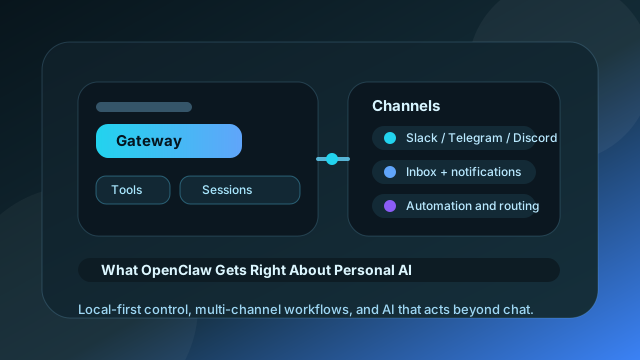
OpenClaw is not important only because it is another open-source AI assistant. It is important because it makes the hidden architecture of personal AI visible. A normal chatbot can stop at a good answer. A personal agent has to keep context, decide when to use tools, handle credentials, and recover when a workflow fails halfway through.
Why OpenClaw feels different
Most AI interfaces are still designed around a single conversation window. That works for research, drafting, and exploration, but it is not how daily work actually happens. Work moves across messages, calendars, files, terminals, dashboards, and long-running tasks.
OpenClaw points toward a more useful model: an assistant that can sit closer to the user and coordinate action across channels. That shift changes the design problem. The interface is no longer just the chat box. The interface becomes the whole operating environment around the assistant.
The engineering lesson
The hard part is not simply connecting a language model to a few APIs. The hard part is building a control plane around the model. A serious personal agent needs a way to represent capability, identity, memory, tool access, and user intent without turning every instruction into an uncontrolled action.
That makes OpenClaw useful to study even if you never deploy it directly. It shows the difference between an AI demo and an AI system. Demos optimize for the impressive moment. Systems optimize for repeatability, observability, and failure handling.
What a production-minded agent needs
- Permission boundaries that make powerful actions explicit instead of accidental.
- Tool isolation so a broken or malicious extension cannot quietly inherit full trust.
- Memory discipline that separates durable preferences from temporary task context.
- Audit trails that explain what the agent did, which tool it used, and why.
- Recovery paths for partial failures, stale credentials, rate limits, and ambiguous requests.
These are not decorative features. They are the difference between a helpful assistant and risky automation. The more an agent can do, the more its surrounding architecture matters.
The product opportunity
OpenClaw also shows why personal AI will probably not be won by the prettiest chat UI. The winning products will be the ones that fit into existing work, reduce repeated coordination, and let users delegate without losing control.
That requires a calmer product philosophy. A good agent should make capability visible, risk understandable, and state inspectable. Users should know what the assistant remembers, which integrations are active, and where human confirmation is required.
My takeaway
OpenClaw is a useful signal for builders because it moves the conversation from “Can the model answer?” to “Can the system act safely?” That is the right question. The next wave of AI products will be judged less by isolated model intelligence and more by the quality of their harness: tools, memory, permissions, monitoring, and human control.
For developers building local-first AI, RAG products, or assistant workflows, OpenClaw is worth studying as a reference point. It shows both the promise and the pressure of agentic software. The opportunity is real, but the implementation bar is much higher than a chat interface with a few buttons.